"THERE ARE NO WRONG NOTES" - MILES DAVIS
SCALECHORD MAGIC
ScaleChord Magic:
See the Structure. Hear the Language. Play with Confidence.
ScaleChord Magic reveals the elegant structure already present in music — allowing musicians to see it, hear it, and play with greater confidence. Simplicity!
The goal of SCM is simple: reveal the relationships already present in music.
"If you know the scale for each chord, it becomes almost impossible to play a wrong note."
– Ernie Watts
ScaleChord Magic is a visual system that reveals how scales, chords, and harmony connect.
Instead of memorizing patterns, musicians can see the structure of music clearly.
How To Use
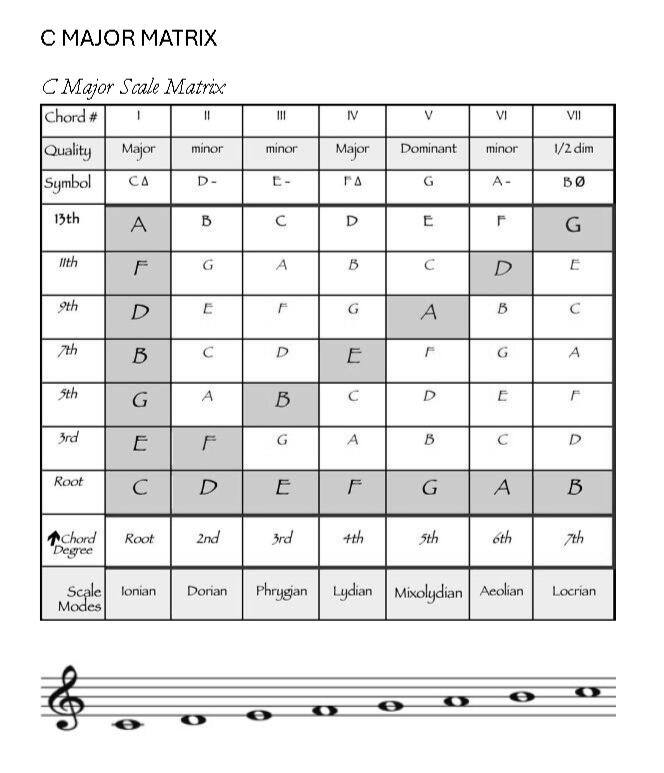
The matrix pages are graphic, musical representations of the 12 major scales, modes, and scale chords found in western music. Each scale is graphically displayed:
• by letter-name diatonically (2nds, in rows),
• in 3rds (by column, and 4ths (diagonally);
• in Mode (Dorian, Lydian, Aeolian, etc.);
• by quality (Major, minor, Diminished, etc.);
• by chord degree (3rd, 5th, 9th, etc.);
• with chord symbol ( Δ, ); and number (II, V, I, etc.).
• in music notation (treble & bass clefs).
Play each scale / chord from root to the 13th to hear it's distinctive sound and do the same with each mode.
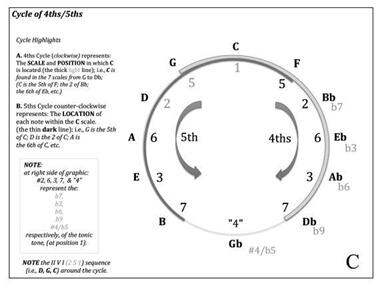
The diagrams of the cycle of 4ths (clockwise) reveal more of the magic inherent in the circle.
Each of the 12 tones of the chromatic scale is graphically displayed for easy reference and memorization.
Tip: Notice below that each three-tone sequence clockwise around the cycle reveals a II V I chord progression, both major and minor.
Note the numerical sequence: 1 5 2 6 3 7 in both directions from the tonic note at '12 o'clock'. The sequence is the same in each direction but each direction reveals different meaning.
A careful look will uncover its secrets.
Now, read it in reverse; clockwise from: 7 3
6 2 5 1. The 7 3 6 sequence = a minor chord progression in C (B
Ø, half-diminished, E minor, A minor).
The next clockwise sequence = the 2 5 I in C = II minor, to V7 Dominant, to I tonic.
The magic is repeated around the cycle when position "1" tonic tone changes (i.e., F, Bb, Eb, etc). See more description in the graphic.

THE CHROMATIC SCALE
SCM AUDIO COMPANION LIBRARY.
THESE RECORDINGS ALLOW YOU TO HEAR THE STRUCTURES SHOWN IN THE BOOK.
All:
1. Major Scales
2. Major Pentatonic Scales
3. Minor Pentatonic Scales
4. Blues Scales
5. Major Scales in 3rds
6. Major Scales in 4ths
TOTAL = 78